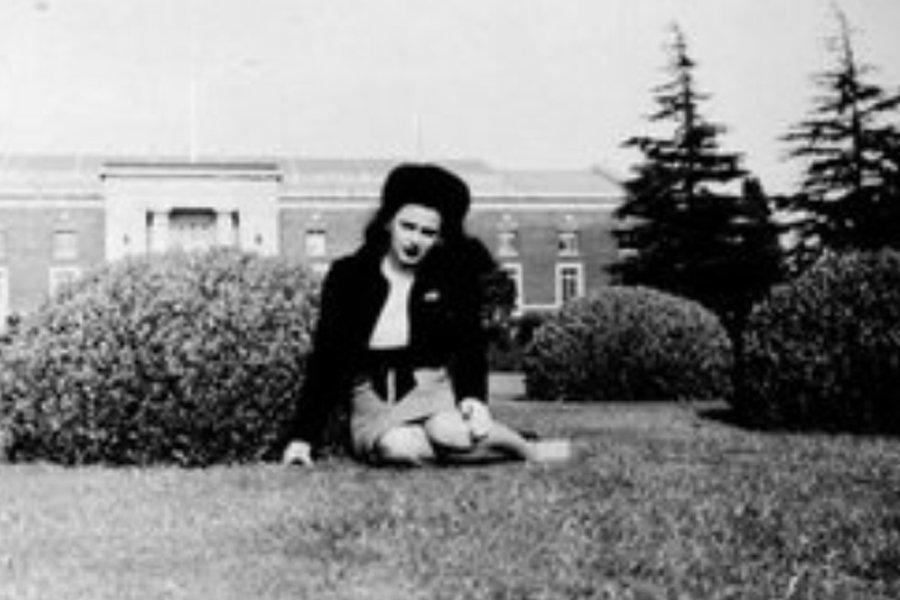
A woman rooted in the prairie
Lucille Harriet Bennett was born on January 21, 1912, in Minnehaha County, South Dakota, and that beginning matters. The prairie does not make legends in the usual sense. It makes endurance. It shapes people with wind, labor, distance, and the long discipline of ordinary days. Lucille’s life seems to belong to that landscape. She was not built for spectacle. She was built for continuity, for the kind of strength that keeps a household upright when the weather turns rough.
Her later name, Lucille Harriet Bennett Olander, carries the trace of a life that crossed from one family identity into another. The names themselves feel like fence posts in a broad field, marking a passage through time. Bennett belongs to her birth family, to the roots that held fast in the upper Midwest. Olander belongs to marriage, to the branch that spread outward into a new home, a new role, and a new generation. Between those two names lies the story of a woman whose life was measured less by public recognition than by the fabric she helped hold together.
The Bennett household and the shape of kinship
Lucille was born into a family with deep lines of connection. Her parents, Albert Eugene Bennett and Anna Marie Carlson Bennett, place her within a household shaped by migration, work, and cultural inheritance. On one side stand the Bennetts, and on the other the Carlsons, each line carrying its own memory. The grandparents add further depth: Madison Bennett and Mary Louisa McMackin on her father’s side, Karl August Karlsson and Hedda Mathilda Johnsdotter on her mother’s side. These names do more than identify ancestors. They reveal a web of history that stretches across regions and across time.
Lucille was one of five children. Her siblings were Doris Irene Bennett Frislie, Clifford Eugene Bennett, Myrna Marie Bennett Anderson, and Norma Geraldine Bennett Means. A family like that is never just a list. It is a working system of shared meals, chores, arguments, loyalties, and private jokes that vanish unless someone remembers them. In a home like the one Lucille grew up in, identity would not have been forged in solitude. It would have been hammered out in a crowded kitchen, in the rhythm of shared responsibility, in the daily awareness that each person mattered to the others.
That kind of family structure can feel like a woven mat. Remove one strand and the pattern changes. Lucille was one strand, but an important one. Her life was not separate from the family story. It was one of the threads that gave the whole design its shape.
Marriage and the long middle years
Lucille married Warner Carl Olander on August 23, 1930, in South Sioux City, Nebraska. That marriage became the central adult partnership of her life, and its length suggests a union that weathered the full range of domestic life. Marriage in the early and middle twentieth century often meant adaptation on a scale that modern people can barely imagine. It meant making do, moving when necessary, stretching money, caring for a child, and maintaining steadiness while the world kept changing outside the door.
The marriage also carries a striking sense of origin. Family memory says Lucille and Warner met at a Swedish Lutheran Church they helped build in Rowena. Whether told as legend or lived as fact, the story gives the marriage a sturdy symbolic frame. It suggests not a romance of flash and glitter, but one of labor and shared belief. Two people meeting through the work of building a church is the kind of detail that feels almost carved from wood. It has grain. It has weight.
Their life together lasted for decades. Warner died in 1992, long before Lucille’s own death in 1995. By then she had already passed through the chief seasons of partnership, motherhood, and grandmotherhood. The long span of the marriage hints at a household held together by habits as much as by feeling. Meals were made. Rents or mortgages were paid. Moves were managed. Grief and joy were both absorbed into the same domestic vessel.
Motherhood and the first stage of Mamie Van Doren
Lucille’s only publicly documented child was Joan Lucille Olander, later known to the world as Mamie Van Doren. Born on February 6, 1931, Mamie would become an actress, singer, model, and celebrity. That fact places Lucille in an unusual position. She lived far from the glare, yet one of the most visible women of her era came from her home.
A mother often leaves no monument, yet she becomes the first environment a child ever knows. She is weather, rhythm, language, structure. She teaches the body what safety feels like and what routine sounds like. In Lucille’s case, that invisible labor mattered beyond the household because her daughter went on to live a public life. Fame may have belonged to Mamie, but the early foundation belonged to Lucille.
The move of the family over time adds another layer to that story. In 1939, they left Rowena for Sioux City, Iowa. Then in May 1942, they moved to Los Angeles. These are not just dots on a map. They show a family following the shifting routes of American life. Rural roots gave way to urban and then coastal life. The journey from South Dakota to California mirrors a broader national movement, as families sought work, stability, and new chances in a changing century.
Grandmotherhood and the widening circle
Lucille became a grandmother when Perry Ray Anthony was born on March 18, 1956. That event may seem small to the outside world, but in family life it is a hinge. A new generation arrives, and the older generation is suddenly visible in a different light. The chain extends. The lineage breathes again.
Grandmotherhood often reveals the real scale of a life. A person may never have owned a business, held office, or stood on a stage, yet their influence can still travel through blood, memory, and example. Lucille’s reach extended through her daughter and into Perry Ray Anthony. She stood at the center of a family that continued moving outward like ripples on still water.
The family tree around her is dense with names, but those names are not dead wood. They are living markers of continuity. Albert Eugene Bennett, Anna Marie Carlson Bennett, Warner Carl Olander, Joan Lucille Olander, Perry Ray Anthony, and the siblings who surrounded her all form a chain of presence. Lucille sits in the middle of that chain, not as a footnote, but as a vital link.
A life lived in the domestic register
Lucille Harriet Bennett appears to have lived without a public career, and that absence is part of her story. It would be easy to overlook such a life because it did not leave behind headlines or professional credits. That would be a mistake. Domestic life is the hidden machinery of history. It is the spinning wheel behind the curtain, the ledger that never reaches print, the hearth that keeps the whole house from going cold.
A homemaker works in a language of repetition. Meals must be made again. Laundry must be washed again. Children must be watched over again. Money must be made to last again. This kind of work does not accumulate in trophies. It accumulates in stability. It builds a family’s memory of what normal feels like. Lucille’s life seems to have unfolded in that register, where care matters more than applause.
Her story also carries the quiet dignity of restraint. Not every life is meant to expand into public record. Some lives create their meaning through proximity, through consistency, through the slow and invisible shaping of others. Lucille’s significance lies partly in that very invisibility. She helped sustain a family that would later become known through her daughter, yet her own value stands apart from celebrity.
Final years in a private place
Lucille died on August 27, 1995, in Newport Beach, California, at the home of her daughter. She was 83 years old. Her death was caused by cancer. Warner had already died three years earlier, and that means her final years were lived after the loss of the partner who had shared most of her adult life.
There is a certain tenderness in that ending. She did not vanish into a public institution or a distant archive. She died in the home of family, in a place shaped by intimacy rather than ceremony. The image feels intimate and plain, like a lamp still glowing in a quiet room after dusk. Her life closed where family remained, which seems fitting for someone whose deepest role was always bound to home, kinship, and the steady work of keeping a family whole.
The House That Keeps Its Cool And Locks Its Doors
What Experienced Home Buyers Notice Before They Say Hello
Finding A Jeweler Who Makes Special Moments Shine